
What has changed
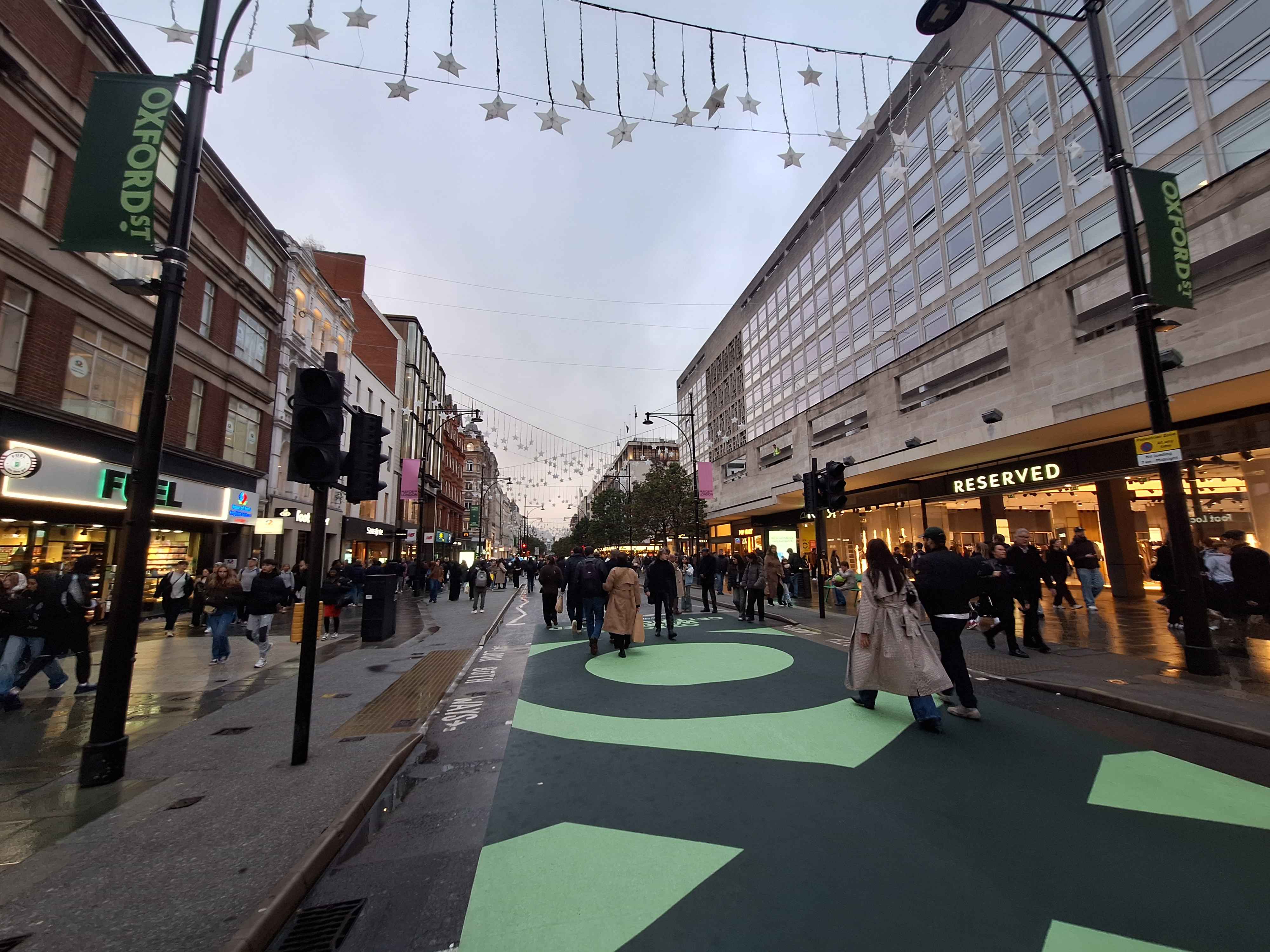
London's Oxford Street became a pedestrian-only zone on Monday along a 1km (0.6-mile) stretch running from Great Portland Street to Orchard Street. It is the first phase of how the mayor's office plans to permanently remove vehicles from the street. Al Jazeera's photograph of mayor Sadiq Khan standing in the middle of the road to mark the first phase is dated 26 October 2026.
On Monday morning, by force of habit, most pedestrians were still sticking to the pavement. Mark Arbouine, a forensic scientist out for a stroll, was one of the few who broke ranks. "I saw there was no traffic today, so I thought, why not walk in the middle of the street and take advantage of it?" he told Al Jazeera. "I just think it's great for the environment, great for shopping. It's just so much easier to move around the street."
A biology teacher, Muneera Alfadhel, described it more simply. "It's magical," she told the outlet from under her umbrella, on what Al Jazeera describes as a characteristically rainy, grey day in London.
Why it matters to retailers
About 1% of the UK's annual gross domestic product is generated along this 1km stretch of street, according to Al Jazeera. In recent decades, though, Oxford Street has been hit by lower consumer spending as well as falling rents and footfall, which is now just 57% of its 2006 level, according to the retail trade body New West End Company.
The Greater London Authority, also known as City Hall, believes pedestrianisation could offer a lifeline. City Hall analysis, as reported by Al Jazeera, suggests the partial pedestrianisation could generate more than $109m per year and support an additional 700 jobs. After a weekend trial in October 2025, two-thirds of businesses in the area said they had higher or similar sales figures during the pedestrianisation, according to the same analysis.
Those figures come from the authority promoting the scheme and a trade body representing West End retailers, and have not been verified independently by this desk.
The current phase is the first step in a multi-phase regeneration project that is to add two public squares, 50 trees and hundreds of public seats.
The objections
Doubts from local representatives have not gone away. Councillor Tim Barnes, deputy leader and cabinet member for growth and planning for the City of Westminster, said residents were not being listened to. "There has been a communication process with residents, but it's been pretty much one way," he told Al Jazeera. "Mostly, they are being told what's going to happen to them and how it's going to happen … But realistically, those who know the street best haven't really been listened to."
Barnes believes the economic benefits are overstated and do not consider the impact of displacing bus routes from a major road to the surrounding, smaller streets. That fear is shared by resident Nerma Cridge, who told the outlet that London's West End will become "completely unliveable, too crowded and too noisy at night". She said the work "should be done in a much more productive relationship with communities".
Ahead of the change, on the Saturday before the road closed, not all shoppers were convinced. One told Al Jazeera that accessible bus services mattered: "People with disabilities who cannot walk a lot – that would be really helpful if the buses move on and they don't discontinue [them]." A second shopper's remark that "it would be good" because "sometimes you're tired; sometimes it's raining" is printed by Al Jazeera as a separate quote, but the outlet does not say whether the two speakers are different people. Al Jazeera also reports that a French tourist said he would avoid Oxford Street altogether if buses and cabs were no longer allowed through.
A long, contested road
Mayor Sadiq Khan first tried to pedestrianise the street in 2017, after a manifesto pledge. The plan fell apart in 2018, when Westminster Council — then responsible for Oxford Street — withdrew its backing, saying residents did not support it. After a public consultation, Khan created the Oxford Street Development Corporation, moving responsibility for the street from local officials to the Greater London Authority and Transport for London.
Barbara Stoll, a campaigner on greener, more walkable cities, said the noise on the street was already considerably lower. "It's amazing coming here this morning. Walking down the street, it was already so uplifting that the noise is considerably lower," she said. "People are excited. I saw people coming up from the tube and looking around. Seeing that, it's almost like children when it's Christmas Day."
She said examples from across Europe and the world showed such projects make life better for local residents, adding that retail gets a boost, air pollution falls and people take back the space.
Al Jazeera reports that the Oxford Street Development Corporation will test and review the results in the coming months and will be "reviewing its findings early next year". According to the outlet, transitioning the rest of Oxford Street into a permanent, traffic-free public space is expected to go ahead "by the end of next year".
Ahead of mayoral elections in 2028, the scheme could be one of the last major initiatives Khan signs off.
Sumber: Al Jazeera English


No comments yet. Be the first!