
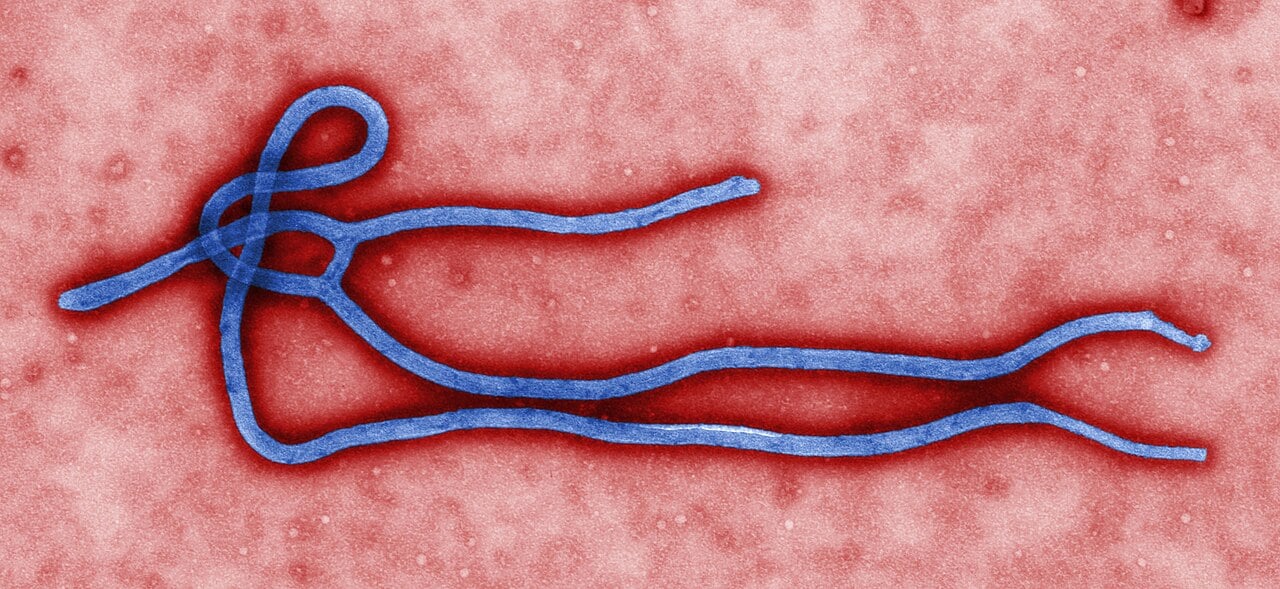
Outbreak crosses five figures
Africa's Ebola outbreak has passed 10,000 confirmed cases — 10,091 in total and 10,060 in DR Congo — the Congolese health authorities said on Tuesday, reporting 4,887 deaths.
Two people have also died in Uganda and two in Kenya, the Guardian reported. The DRC's National Institute of Public Health put the fatality rate at close to 50 percent, and 2,684 patients have recovered.
The epidemic is driven by the Bundibugyo species of Ebola, for which no vaccine or treatment is approved. Testing has begun in recent weeks to establish whether the Ervebo vaccine, which is effective against the more common Zaire strain, also protects against Bundibugyo, the Africa CDC said; Kaseya told the Guardian results should be available in three to six months.
The outbreak was declared in Ituri province in north-eastern DRC on 15 May, although sequencing indicates the virus had begun spreading in February. It is the 17th Ebola outbreak recorded in the country and the largest and deadliest in its history. Africa CDC Director-General Jean Kaseya told AFP the outbreak has since reached eight provinces and more than 66 health zones — an area he described as around twice the size of the UK.
Kaseya warns of a Covid-style spread
By Wednesday, Kaseya had described the geographic reach of the outbreak as unprecedented and warned that without stronger preparedness it could reach the UK and other countries. Kaseya told the Guardian: "Each country, not only in the African region, but all continents, must now increase the preparedness level and the possibility for treatment." He added: "It is the first time three African regions have been affected [by Ebola]. The geographic extension of this outbreak is unprecedented," he said.
He drew a direct comparison with the early weeks of Covid-19, saying countries that once believed they faced no risk could quickly become hotspots. He then warned about the UK. "We shouldn't forget that at the beginning of Covid, many countries said there was zero risk of being affected, but a few months later, they became the hotspot," he said. "We don't want to see the UK and other countries become the hotspot."
The World Health Organization has warned that Africa faces a "complex" task in containing an outbreak spanning the east, west and centre of the continent. Cases have been recorded in Kenya and Uganda in east Africa and in Nigeria in west Africa. Kenya, which had not reported a single case before 6 October, has now recorded nine cases and two deaths, and Uganda was declared Ebola-free by the WHO in late August after 20 cases and two deaths. Nigeria's single confirmed case — a 42-year-old Swiss woman who fell ill after travelling to Uganda — was evacuated to a hospital in Geneva on Monday.
France remains the only non-African country to have confirmed a case, a doctor who had returned from DR Congo in June.
Aid shortfall and insecurity hamper the response
The response has been hampered by inadequate protective equipment and unpaid health worker wages that have led to strikes, while conflict in DR Congo, as well as mistrust towards officials in affected areas, misinformation and global aid cuts, has further complicated the situation. A nurse was killed and a health worker seriously wounded in north-eastern Tshopo province on Saturday, according to the WHO; Doctor Marcel Likolo, chief medical officer of the Bafwasende health district, told AFP that young people in the area had accused the victims of trying to infect locals with tablets before attacking them, and he said the treatment centre where the incident took place has since shut.
Kaseya is convening African health ministers on Wednesday to urge greater cross-border cooperation, including screening and testing at points of entry and exit. He said governments have pledged $3bn (£2.3bn) for the response but that more than $2bn remains outstanding, with African countries having committed $120m and the rest expected from international donors including the US, the UK and the EU. "We need this money now," he said. "We must understand that failure to provide funding now to African countries [will result in more being spent] because the outbreak will continue to move."
Why this matters
For readers outside Africa, the warning is a test of how quickly governments treat distant outbreaks as local risks. Kaseya is asking every continent to raise preparedness now, arguing that paying for prevention is cheaper than containing a wider spread later — the same logic that decides how far governments go on travel screening, laboratory capacity and public information campaigns. Stateline MEDIA has followed the outbreak's African expansion, including the <a href="https://statelinemedia.world/en/article/2026-10-18-ebola-kenya-cases-rise-to-seven">rise to seven cases in Kenya with three health workers infected</a> and the <a href="https://statelinemedia.world/en/article/2026-10-18-ebola-kenya-cases-rise-to-seven">second Ebola death in a Nairobi quarantine cluster</a>, as well as how the <a href="https://statelinemedia.world/en/article/gejala-tbc-kasus-jaksel">strain on public health services is measured in case counts</a>. The WHO's own risk assessment, last revised on 14 August, rated the global risk as low while a revision is under way in light of new information.
Developing story
This is a developing story. Confirmed case numbers by country outside DR Congo, the number of health workers affected and projections for further spread have not been fully established. This article will be updated in place as official figures change. Last updated: Wednesday, 28 October 2026, 12:40 UTC.
Sources
Source: The Guardian, World Health Organization (Disease Outbreak News, 23 October 2026) and AFP via The Korea Times.



No comments yet. Be the first!